
Foreword
“Walking with Zero” is a special interview series launched by L.U.C (Lizard Undersea Cinema), created to accompany Zero Day Attack (2024)—a Taiwanese national security drama that cuts across politics, media, history, and public emotion—as it moves toward its final episodes.


Unlike conventional promotional interviews, this series is not only about disseminating information related to Zero Day Attack. Our aim is to dig beneath the surface, to uncover the stories and unresolved tensions behind a work that feels unprecedented—and very likely, one that may never be replicated again.
This project also exists as a form of testimony: for those who were willing to take the risk of speaking on record, and for our own era—to ask how we, as a society, choose to face a drama like this, and what it means to leave a trace of that encounter.

Interviewing Su Yi-Hsuan, whom we called Director Su, felt surprisingly effortless. Talking to her, we never felt the need to over-censor ourselves—though she joked that she was more worried about speaking too frankly and accidentally saying something she shouldn’t. For this L.U.C (Lizard Undersea Cinema) interview conducted by me and Digua, she spoke with disarming openness, despite the fact that we had no prior connection before this conversation.
Seeing Taiwan from France: Life Under Layers of Colonial Shells
It was only when she went to France to study film that she realized how different Taiwanese people really are. Watching how the French treated protest as something ordinary, almost casual, gave her a kind of cultural whiplash.
“Of course, the French also complain about the inconvenience caused by strikes,” she said, “but they still see striking as a normal way to fight for their rights.”
“Maybe it’s because Taiwan’s colonial background is so diverse that Taiwanese people tend to be more…”
“Compliant?” I offered.
“Yes,” she nodded.
From the Dutch to Koxinga, from the Qing Empire to the Japanese, and later the KMT (Kuomintang, the Nationalist Party of China), we have long been conditioned to adapt ourselves to whichever ruling power arrives. We learned their languages, absorbed their cultures, and even accepted their bloodlines. It’s as if we are some kind of soft-bodied creatures, and whenever someone hands us a shell, we put it on without question. That shell—something placed onto us rather than something grown from within—becomes our form.
“Of course,” she continued, “this has two sides. It allowed our society to develop quickly, but it also left us without a solid historical foundation.” She referenced Professor Rwei-ren Wu’s introduction to Ming-Min Peng’s A Taste of Freedom (1971), where he emphasized the importance of history: ‘We have no real connection to our own past.’ Without that connection, everything feels fragile, easily overturned. We are still, in many ways, just beginning to explore what our own form should be.


The Mildness of Taiwanese Protests—and the Backlash Against Them
“Compared to other countries, Taiwan’s modern protest movements are already quite mild,” she said.
“But even such restrained activism still triggers backlash among Taiwanese people.”
She paused for a moment, aware of how her next line might sound. “It might be politically incorrect to say this, but failure in movements is very common. Over time, people’s ideas change, compromises happen, political tides shift, and movements fracture. People need to get used to that reality. Protest is full of compromise.”

In her previous film Who’ll Stop the Rain (2023), she wondered if she had dramatized student protests too much. Because in reality, Taiwanese student movements are not like the high-intensity street battles seen in Western footage—they are often too peaceful, too polite, too… restrained.

Episode 3: “On Air” — Between Professional Ethics and Emotional Tension
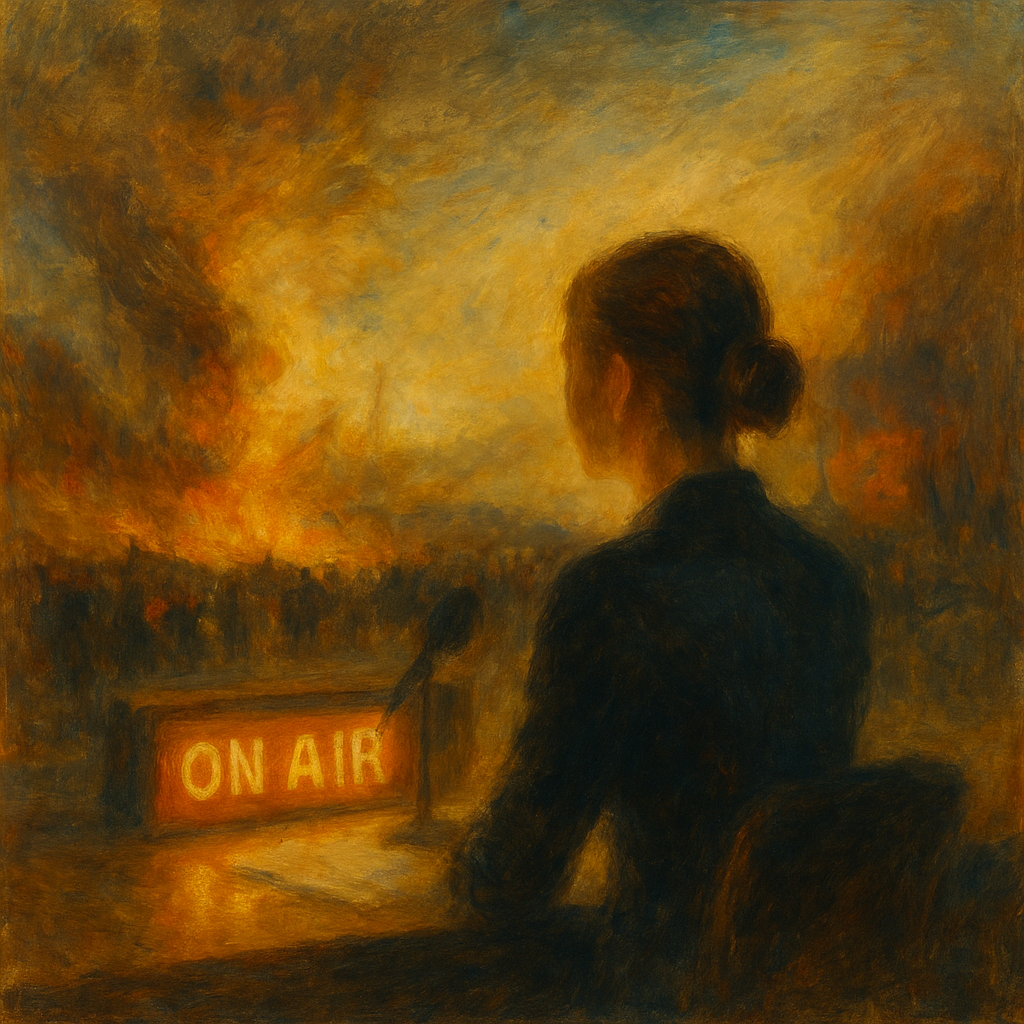
In episode 3, “On Air” of Zero Day Attack (2024), protest imagery appears again, but this time it plays out in a divided civil space. One side calls for peaceful unification under external military threat; the other calls for independence and autonomy. But unlike Who’ll Stop the Rain (2023), the protagonist here is not a student activist. She is a TV news anchor, holding onto her professional ethics at a time when the internet has gone dark, cable news is resurrected, and broadcast stations start chasing sensational headlines instead of verified truth.
Beside her stands an assistant—a man who has returned after years away, carrying a hidden mission: to protect the CEO.
Between Market and Creation: Negotiating the Shell

“Originally, ‘On Air’ was going to center around a romance between two women,” Director Su said. “I heard that the first episode originally featured a lesbian president couple, but it was changed to a straight couple, and then later that was changed again.”
She didn’t elaborate on why it was altered. She didn’t have to. Whether it was market pressure or something else, it was clearly another kind of shell—one that dictates what forms are allowed to appear. Both I and Digua felt a sense of loss. We loved the way Who’ll Stop the Rain (2023) portrayed queer relationships with tenderness and grit.
“I still hope I can write something better next time,” she said, half laughing. “Something that will make lesbian audiences actually leave their houses, stop petting their cats, and come out to support it.”
Even though Who’ll Stop the Rain (2023) unexpectedly attracted a younger audience, its box office performance still had room to grow. That commercial reality was one of the factors she had to weigh when rewriting “On Air”. A film is not just the director’s personal creation—it’s a collaborative product, a commodity, and a container for ideas. Balancing all three is its own kind of struggle.
But even with market pressure, she remains committed to women’s perspectives and female agency on screen.
Working with Actors: Lien Yu-Han and Issey Takahashi
Talking about her long-time collaboration with Lien Yu-Han, whom she first met through Lost and Found (2013), she noted a transformation. “Ten years ago, when I started reading The Century Pursuit: The Story of Taiwan’s Democratic Movement, Yu-Han couldn’t fully grasp it yet. But after years of research and acting, she’s different now. The way she plays anchor Xia Yu-Shan—she’s truly breaking out of her old shell.”
“Most actors have some kind of life issue,” she said. “Those things shape their performance choices. Lien Yu-Han is known for restrained, inward acting. But for this role, I kept telling her: give me more. Push further.”


And what about Issey Takahashi, who plays Fujiwara?
She smiled. “He’s terrifyingly good. He reads a script and immediately understands the internal tone I’m aiming for. The role has spy thriller elements, but he still keeps it delicate, finely tuned.”
“He’s an actor who even dared to take on Wife of a Spy (2020), a film that directly critiques Japan’s militarist government. I think he saw something meaningful in Zero Day Attack (2024)—that’s why he joined.”
A Non-Typical Love Triangle and the Weight Placed on Women

In “On Air”, Issey Takahashi’s Fujiwara, Lien Yu-Han’s Xia Yu-Shan, and Yang Da-Zheng (Fire EX.’s vocalist, here playing Sun Qi-Jun) form a non-typical love triangle. To Xia Yu-Shan, Fujiwara is the ex-lover who disappeared without a word years ago. Sun Qi-Jun is the ex-boyfriend who has now become her colleague in the TV station. He cares about her, but at the same time expects her to perform traditional femininity to stay safe in the hierarchy.
For women, national conflict is not enough—they must also handle past lovers, present expectations, internet blackouts, corporate pressure, and men in black suits chasing them down. How do you hold on to your values in such a world? How do you process your own emotions and trauma while navigating power structures? Do you obey the system? Or do you submit to the darkness lurking outside it?
This is why, even amid the thriller pacing of “On Air”, Director Su insisted on inserting moments of emotional narrative.
Why Emotional Education Matters

“People keep saying emotional scenes in something like Demon Slayer are unnecessary,” she said, “but those quiet emotional moments—those are the reasons behind action. That’s what justifies movement.”
“If we could understand our own emotions and express them properly, things would be better. We really lack emotional education.”
Emotional education—a term that echoes both Flaubert’s Sentimental Education (1869) and, in a modern sense, the urgent need to understand how people process feelings in an age of accelerated information and constant crisis.
And perhaps that is just as vital as whether media infrastructure is owned by domestic corporations or whether your home router—with its potential backdoor—was manufactured in a hostile country.
Looking Forward
Before we ended, Director Su told us she is developing a new fantasy romance series set in Taiwan during the Shōwa era. “It’s not a lesbian story either,” she said, slightly amused, “but it still has a shell I want to break.”
As a land of ferns and microchips, an island where the ancient and the futuristic overlap, Taiwan is still fighting against the shells others have forced upon it—and still searching for one it can call its own. We get hurt, we repair ourselves, and then we grow tougher.
The only question left is: How much time do we have?

Author’s Note:
In his foreword to A Taste of Freedom, Professor Rwei-ren Wu wrote: “This generation naturally assumes they are Taiwanese, but rarely do they engage in critical reflection on the foundational values and visions behind that identity. They can recite historical events and figures, yet have little clear understanding of which past we come from, how our community was formed, where we stand, and where we should go…”