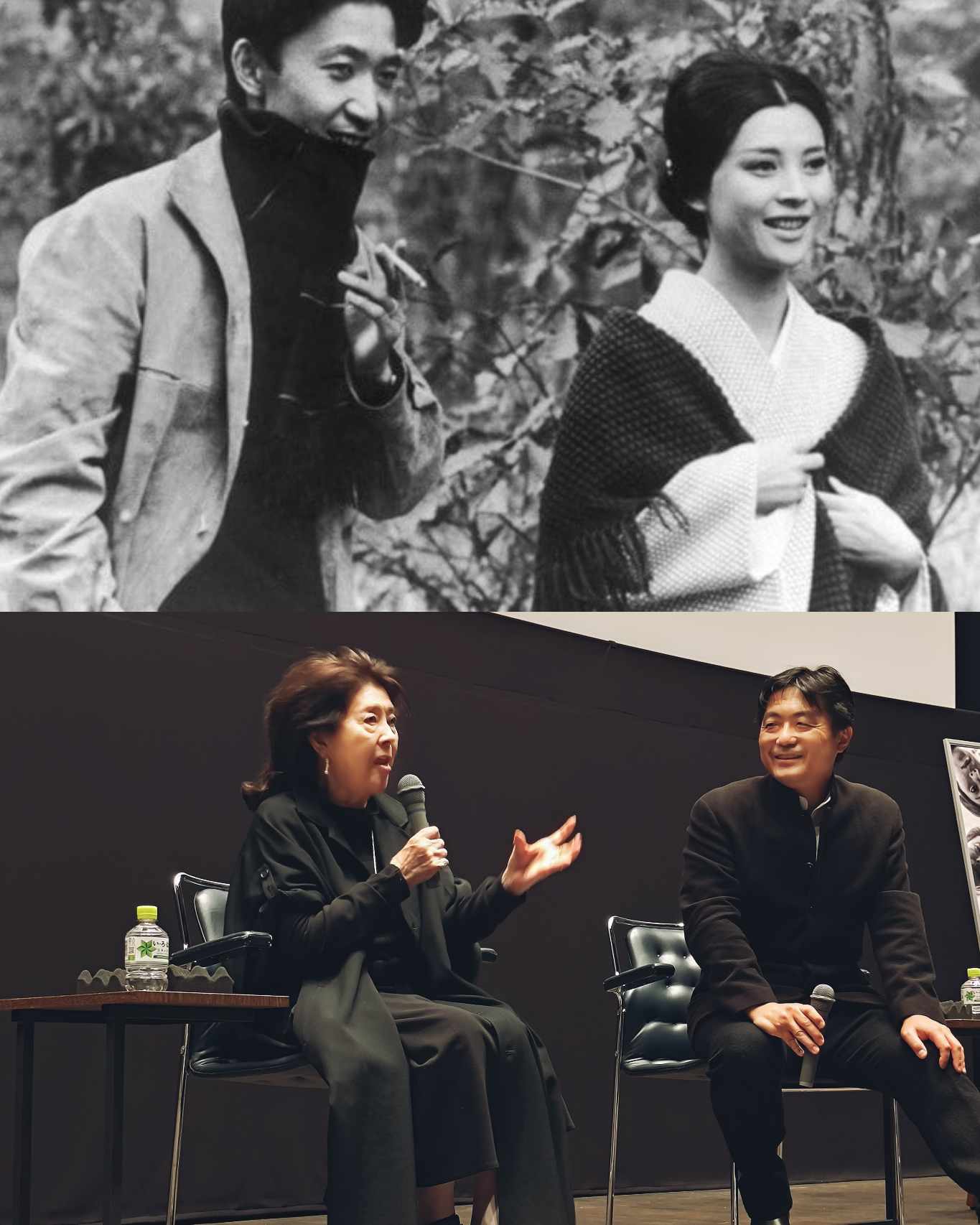

“I’ve always wanted to film Shinji Fujiwara’s ‘Akitsu Springs’ but was constantly rejected by Shochiku,” she revealed.
“When I was about to shoot my hundredth film, they finally agreed to let me film ‘Akitsu Springs.’”
The lady on stage recounted memories spanning over sixty years, and now at over ninety years old, sometimes she doesn’t react to the host’s words on stage.

During the 37th Tokyo International Film Festival, in collaboration with the National Film Archive of Japan in the ‘TIFF/NFAJ Classics Directors: Yoshishige Yoshida’ segment, she was reviving ‘Akitsu Springs’ for the audience. This film was her first collaboration with Yoshida, in an era right after the war, a time when the old order was crumbling and a new era was emerging. By then, already in her thirties, she had acted in ninety-nine films and had worked with great Japanese directors like Mikio Naruse, Keisuke Kinoshita, and Yasujiro Ozu

Facing her, a cinema senior, was Yoshida who had joined Shochiku only seven years after university. He was fascinated by violence, believing that beneath the surface of post-war Japan’s peace and prosperity, many were oppressed and exploited. Originally intending to teach at a university, he felt that contemporary directors should no longer just focus on family themes but should address the struggles of the youth who had nowhere to go, or those who couldn’t find their place in the new society.

Such new times called for a new style of cinema. Yoshida’s scripts were concise, emphasizing actor performances, skillful use of film language, highlighting moments of silence, and adept at guerrilla filmmaking, all of which starkly contrasted with the era of studio filmmaking in Japan.
Already famous by then, Mariko Okada saw the potential in this budding director. Although initially, she didn’t think Yoshida, who preferred original scripts influenced by the French New Wave, would accept the job of filming ‘Akitsu Springs,’ not only did Yoshida take on the work, but love also blossomed between them during the process. Despite the difficulties encountered during filming, including the illness of the original male lead Akira Kawaguchi, who had to be suddenly replaced, and the death of her mother, the experienced Okada tirelessly worked with Yoshida to complete the film.

“I designed every outfit for Shinko.”

At the start of the film, Shinko was still in her teenage years, wearing brightly colored outfits. As the plot developed and her relationship with the male lead deepened, the colors of her outfits intensified, such as a kimono with a white base and red flowers; as their relationship gradually cooled, the colors of Shinko’s outfits dimmed, turning to cool tones like blue and purple.
In the final scene of the movie, Shinko wore a dark kimono patterned with white.
“In choosing this outfit, I didn’t deliberately cater to the character’s sorrowful emotions but selected it based on the needs of the scene, to avoid overly emphasizing the character’s emotions and affecting the natural expression of the performance.”

For her now, memories are very distant, and each climb makes them even more so. The man she chose and married a year after filming ‘Akitsu Springs,’ and with whom she founded the independent production company Modern Film Association in 1966 after leaving Shochiku, had passed away two years ago. Together they had faced and supported each other through a declining studio system, trying to capture the spirit of the times with distinctive works. Now, she alone must carry on those memories.
As memories became clearer, her speech grew more indistinct, silent; she seemed to be watching not only the audience who braved the storm to the National Film Archive of Japan.
“Go for it, Ms. Okada!” “We love your work!”

The continuous cheers and encouragement from the audience lit up the eyes of Mariko Okada, surrounded by wrinkles. Whether or not you understand Japanese, you could see the glowing years in her memories.
Initially planning to conform to the unspoken rules of the film industry and retire from acting after marriage to focus on family, under her husband’s scolding and encouragement, she continued to act in many of his and other directors’ films. Times have changed, women no longer fade out due to age, and no longer have to choose between family and career. She collaborated with Yoshida on several films and continued acting until 2019.
Today, she stands here not just as Yoshida’s widow but also as the producer of ‘Akitsu Springs.’
“He regarded cinema as his life, even in his dreams, he would be filming.”
Her high praise for Yoshida, in fact, reflected her own dedication as well.
The works of Yoshida and Okada are about to be donated to the National Film Archive of Japan, meaning that generation after generation will continue to watch their works and remember the efforts and achievements of Mariko Okada and Yoshida as partners during turbulent times. These are their works, and also their lives.

